Responses Won't Always Be Perfect
Spotify recently announced an AI chatbot, called "Talk to Spotify", that does what you'd expect. Users can ask questions in natural language and it answers. I admit I have not tried it, but reading the announcement made me groan more than excited. This is my way of putting that groan into words.
At the bottom of the article there is a disclaimer saying, "...the responses won't always be perfect". Now, I'm not picking on Spotify specifically here. Most, if not all, the companies launching AI chatbots tack on the same disclaimer.

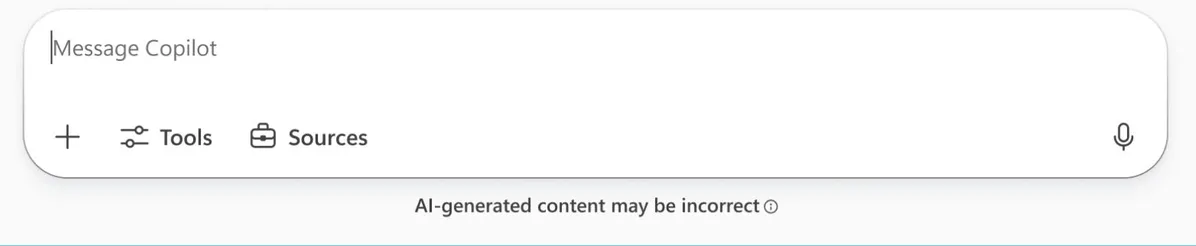 Snap's My AI and Microsoft Copilot's disclaimers
I feel like part of the frustration with companies shipping "boring" AI features is not really about AI at all. It's starting to feel more and more like companies are reaching for AI solutions to either paper over the fact that their UI sucks, or that they have never bothered to build it well.
Here's a pattern that might sound familiar. There is a piece of information or control that you want as the user. Maybe it's buried three menus deep. Maybe the UI is unintuitive and the control exists in a place that makes no sense. But then, what you're presented with is a flashy new chatbot. The promise is that if you whisper the commands following the best practices1, you might get what you want.
A good UI's job is to do the boring but essential task of putting information in front of the user at the right time, and giving them controls to get to where they need to go quickly. A chatbot makes you type or dictate the question (correctly), wait as it thinks, and read back the response.
One of the use cases Spotify highlighted in their demo video is a user asking the chatbot how many times they had listened to the song that was playing. Are you really trying to tell me this is a request so few users have that it wasn't worth building into the UI? This isn't a hard feature to ship, it's a number sitting in a database. Apple Music (on the Mac) shows it to you, and you can sort based on the play count right in the songs list. I'm not nitpicking here, this is literally the second example Spotify themselves decided to highlight. (The first one, to their credit, is a reasonable use of AI. More on that later.)
Why companies are addicted to it
Much has been written about why companies are obsessed with AI (spoiler: it's always money), but I think there's a UI angle here that adds to it. A chatbot is an attractive solution because it is a single door to every question.
Think about how you'd normally design UI. You would have to consider what users are trying to do most of the time, and then find intuitive ways to offer those controls at the right time and place. Or.. you can simply ship a magical little text box that claims to do anything they ask for.
Then we get to the "responses won't always be perfect" part of it, aka, plausible deniability. If a regular old feature doesn't work, users can point to it and complain. They can demand that it be fixed. When an AI chatbot doesn't do exactly what they asked, though, the company has a built-in defense. They could either put the blame on the LLM saying they are nondeterministic and making them more reliable is a frontier research problem. Or they could always fall back to "you're prompting it wrong". The "you're holding it wrong" of the AI era. Either way, they get to deflect a lot of the blame when something does not work, in a way that was not possible before.
We have mounting evidence about this. In 2024, Air Canada's support chatbot hallucinated and told a grieving customer he could claim a bereavement fare retroactively. When he took it to court, Air Canada's defense was that the chatbot was "responsible for its own actions". Thankfully, it didn't work and they had to pay. In 2025, Cursor's support bot invented a policy that didn't exist. It told users they could only run the app on one device, prompting people to cancel their subscriptions. The company's response? "This is an incorrect response from a front-line AI support bot."
I think it is going to get worse as the same companies race to ship agentic AI tools that go beyond answering questions and take actions on the user's behalf. Chatbots are brittle enough as it is, but the issue with agentic tools is that failure modes are harder to reproduce. A broken button throws the same error every time and you can see the pattern across users. The agent did something weird is a fuzzy signal in bug reports, making it hard for anyone to act on.
This deniability is not temporary mind you. We have had chatbots for more than two years now, and they're still graded on a curve. My smart speaker still can't reliably turn on the lights, yet every AI upgrade is sold as the one that finally fixes it. (M.G. Siegler reviewed the new LLM-powered Alexa under the headline "Grading Alexa+ on a Curve", which tells you how well that's going.) "It's rough now, but the models keep getting better. Look at all the benchmarks" is a thing that I hear endlessly. It allows companies to ship something unfinished and defer accountability to an indefinite point in the future.
What is weird to me is that a chatbot is not even a cheap place to hide. The LLM route can be orders of magnitude more expensive than a well-placed UI button or pre-built workflow useful to most users. A pre-built workflow has zero marginal cost, whereas an LLM costs the developer every single time a user queries it. Having it work well means rearchitecting your data so an agent can actually query it reliably. So you often end up worse off: you get a less reliable and slower tool with an experience that's worse than the interface that could have been developed.
So, you get to ship something that you don't fully trust, doesn't quite work, and deflect blame when it breaks. And you can do this all while charging users more for the privilege. Are you really surprised why companies are chomping at the bit to launch these things?
I feel like there's a deeper incentive underneath this. I am empathetic to the challenges software developers face. UI redesigns or traditional feature work have become expected, making it very hard to charge users for them. I think it's fair to say that nobody has ever successfully charged users $3 more because they redesigned the settings page. Meanwhile AI is the one thing that you can seemingly charge more for, and get rewarded for it from the market. Canva, Evernote, and Notion are a few examples of companies doing just that. My annoyance is specifically with companies removing an option to keep paying for their software, without the AI bolted on it. All three of the aforementioned companies have raised prices of their subscription tiers because they now come with AI.
Can it get better?
I want to be fair and say that there is a universe in which these chatbots would be uniquely useful. There is an idea that AI can at some point do just-in-time UI, which is UI that is generated on the spot to cater to the specific request of the user. Writers like Andrew Sims and [Nielsen Norman Group](nng-url have explored how this could work, so I won't go into it here.
The cases where this makes sense is when the user's query is specific to their data and workflow. Requests such as "show me photos I took on days that it rained" are not broadly useful enough that the developer would give them a permanent place in the UI. An AI that makes a throwaway UI on the fly would be great at solving this problem. Such a feature would be purely additive, sitting on top of the interface we have today.
Funnily enough, there is a good example from Spotify themselves. Their demo video shows a user asking for a playlist to fit a specific mood. A playlist that ramps from calm to hype over a 45 minute run is the kind of one-off, personal request that no app will hardcode a button for.
To apply this, I would be asking myself the following question if I were shipping an AI feature today: is the chatbot doing something that is about solving specific, one-off workflows? Or is it repackaging existing UI-based solutions into a text box? The former is worth doing and the latter is trend chasing that is just going to annoy your users.
The ever-shifting rules of prompt engineering. Recite the correct incantation and the machine might cooperate.↩